Introduction Latest trends in digital marketing
Digital marketing has become one of the most important tools for businesses looking to connect with customers, increase brand awareness, and drive growth. Over the past few years, the digital landscape has changed dramatically due to advances in technology, evolving consumer behavior, and the increasing demand for personalized experiences. Latest trends in digital marketing
In 2026, digital marketing is no longer limited to traditional online advertising, social media posts, or search engine optimization. Businesses are now using artificial intelligence, automation, data analytics, immersive technologies, and creative storytelling to build stronger relationships with their audiences. Latest trends in digital marketing
Consumers today expect brands to understand their needs, provide instant solutions, and deliver meaningful experiences across multiple channels. Companies that fail to adapt to these expectations risk losing visibility and customer trust. Latest trends in digital marketing
The latest digital marketing trends focus on one major goal: creating smarter, faster, and more human-centered marketing experiences. Let’s explore the key trends shaping the future of digital marketing and how businesses can use them to stay competitive.
Digital marketing has evolved far beyond traditional advertising and social media promotions. Today’s consumers expect personalized experiences, instant communication, valuable content, and seamless interactions across multiple digital platforms. At the same time, emerging technologies, changing search behaviors, and evolving privacy regulations are reshaping how businesses connect with their audiences.
To stay competitive, brands must embrace innovation while keeping customer needs at the center of every marketing strategy. Businesses that quickly adapt to new trends can build stronger relationships, improve customer engagement, and achieve sustainable growth in an increasingly competitive digital landscape.
Let’s explore the latest digital marketing trends that are transforming the way businesses attract, engage, and convert customers.
Why Keeping Up with Digital Marketing Trends Matters
Digital marketing trends are more than industry buzzwords—they reflect how people discover information, engage with brands, and make purchasing decisions. Search engine algorithms evolve, social media platforms introduce new features, and customer expectations continue to rise. Businesses that stay informed can adapt quickly, improve their marketing performance, and build stronger customer relationships.
Here are some of the key benefits of following the latest digital marketing trends:
- Improve search engine visibility and organic traffic
- Increase customer engagement through personalized experiences
- Generate higher-quality leads and conversions
- Build stronger brand credibility and trust
- Maximize return on investment (ROI)
- Stay ahead of competitors in a rapidly changing marketplace
Latest trends in digital mar
1. Artificial Intelligence Is Redefining Digital Marketing
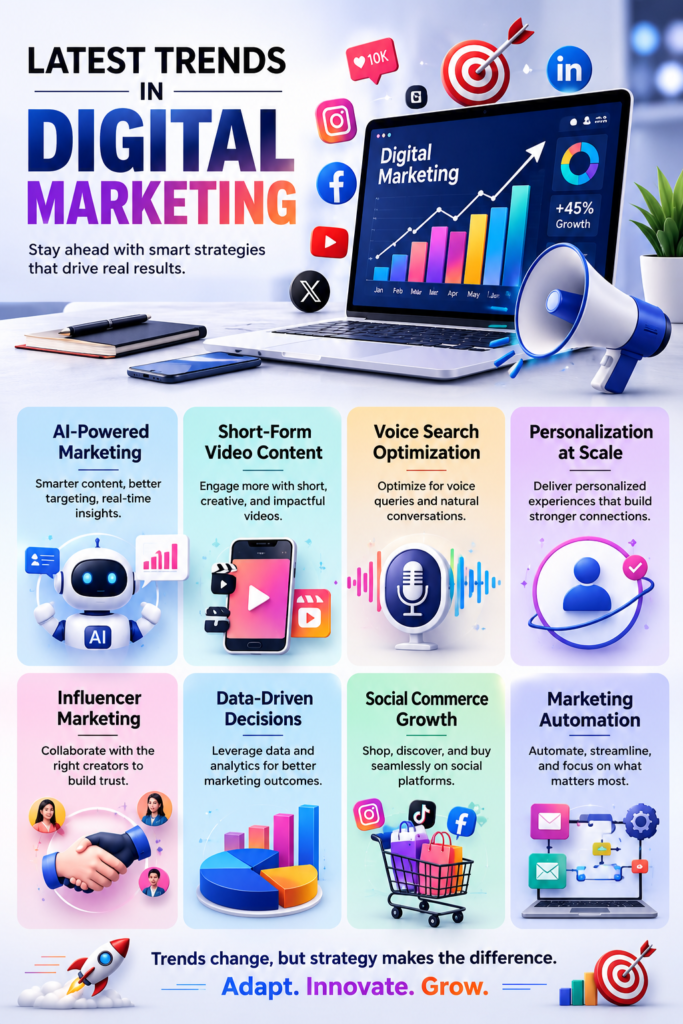
Artificial intelligence (AI) has become one of the biggest drivers of change in digital marketing. From content creation to customer analysis, AI-powered solutions are helping marketers work more efficiently and make better decisions. Latest trends in digital marketing
AI tools can analyze large amounts of customer data, identify patterns, predict buying behavior, and recommend personalized marketing strategies. Businesses are using AI for automated email campaigns, customer segmentation, chatbots, advertising optimization, and content generation. Latest trends in digital marketing
Generative AI has also transformed content marketing. Marketers can now use AI tools to create article ideas, social media captions, product descriptions, images, and campaign concepts. This allows teams to save time while focusing more on creativity and strategy. Latest trends in digital marketing
However, the most successful brands understand that AI should enhance human creativity rather than replace it. Customers still value authenticity, emotional connection, and original ideas. Businesses that combine AI technology with human storytelling can create more impactful marketing campaigns.
Artificial Intelligence (AI) is revolutionizing digital marketing by enabling businesses to automate tasks, personalize customer experiences, and make data-driven decisions. AI tools help marketers analyze consumer behavior, predict purchasing patterns, generate content ideas, optimize advertising campaigns, and improve customer support through intelligent chatbots.
Modern AI platforms can create personalized product recommendations, automate email campaigns, and even assist with content creation while maintaining brand consistency. Businesses are increasingly using predictive analytics to identify customer preferences before they even make purchasing decisions.
Rather than replacing marketers, AI enhances creativity and efficiency by handling repetitive tasks, allowing marketing teams to focus on strategy, storytelling, and customer relationships.
Latest trends in digital marketing
How Businesses Can Use AI Effectively
Companies can implement AI in several ways: Latest trends in digital marketing
- Use AI-powered analytics to understand customer preferences.
- Automate repetitive marketing tasks. Latest trends in digital marketing
- Create personalized recommendations for customers.
- Improve customer service through intelligent chatbots. Latest trends in digital marketing
- Optimize advertising campaigns based on real-time performance. Latest trends in digital marketing
AI will continue to evolve, making it a critical part of modern marketing strategies.
2. Personalization Is Becoming the Standard
Modern consumers expect personalized experiences. They are more likely to engage with brands that understand their interests and provide relevant content.
Traditional marketing approaches that deliver the same message to everyone are becoming less effective. Today, businesses use customer data, browsing behavior, purchase history, and engagement patterns to create personalized campaigns.
Personalization can appear in many forms:
- Customized email recommendations. Latest trends in digital marketing
- Personalized website experiences. Latest trends in digital marketing
- Targeted advertisements. Latest trends in digital marketing
- Product suggestions based on previous purchases. Latest trends in digital marketing
- Content recommendations based on user interests.
- Product recommendations
- Website experiences
- Email campaigns
- Promotional offers
- Mobile notifications
- Content suggestionsLatest trends in digital marketing
For example, online shopping platforms use customer behavior data to suggest products that match individual preferences. Streaming services recommend movies and shows based on viewing history.
Personalization improves customer satisfaction because people feel understood and valued. In the future, businesses that deliver highly relevant experiences will have a stronger advantage over competitors.
3. Short-Form Video Marketing Continues to Grow
Short-form video content remains one of the most effective ways for brands to capture audience attention. The popularity of short video platforms has changed how people consume information online.
Consumers increasingly prefer quick, engaging, and visually appealing content rather than lengthy advertisements. Brands are using short videos to showcase products, explain services, share stories, and connect with audiences.
Popular short-form video strategies include:
- Product demonstrations. Latest trends in digital marketing
- Behind-the-scenes videos. Latest trends in digital marketing
- Customer testimonials. Latest trends in digital marketing
- Educational clips. Latest trends in digital marketing
- Influencer collaborations.
- Quick tips and tutorials.
The success of short videos comes from their ability to deliver value within a limited time. Businesses that create entertaining and informative videos can increase engagement and improve brand visibility.
Authenticity is especially important. Audiences respond better to natural, relatable content than overly polished advertisements.
4. Voice Search Optimization Is Expanding
The increasing use of smart speakers, mobile assistants, and voice-enabled devices is changing how people search for information.
Voice searches are usually more conversational than traditional typed searches. Instead of entering short keywords, users often ask complete questions.
For example, someone may type “best restaurants near me” but ask a voice assistant, “What are the best restaurants near me?”
This shift requires businesses to adjust their SEO strategies. Marketers need to focus on:
- Conversational keywords.
- Question-based content.
- Local SEO optimization.
- Clear and structured answers.
Companies that optimize their websites for voice search can improve their chances of appearing in search results and reaching customers at the right moment.
5. Social Commerce Is Transforming Online Shopping
Social media platforms are becoming powerful sales channels. Consumers are no longer just discovering brands on social networks—they are also purchasing products directly through them.
Social commerce combines entertainment, community engagement, and shopping into one experience. Features such as product tags, live shopping events, and integrated checkout options allow customers to move from discovery to purchase quickly.
Brands are using social commerce to:
- Showcase new products.
- Partner with creators.
- Run live demonstrations.
- Collect customer reviews.
- Build online communities.
This trend is especially valuable for small businesses because social platforms provide opportunities to reach targeted audiences without relying only on traditional advertising.
6. Influencer Marketing Is Becoming More Authentic
Influencer marketing continues to be an important digital marketing strategy, but the industry is changing. Brands are moving away from focusing only on celebrities and large follower counts.Influencer marketing has matured significantly over the past few years. Instead of relying solely on celebrities with millions of followers, brands are increasingly partnering with micro-influencers and nano-influencers who have smaller but highly engaged audiences.
Consumers today value authenticity over popularity. They are more likely to trust recommendations from creators who consistently share genuine experiences and build strong relationships with their communities.
Types of Influencers
Nano Influencers
Typically have fewer than 10,000 followers but often achieve exceptional engagement rates due to their close-knit communities.
Micro Influencers
Generally have between 10,000 and 100,000 followers and are known for their expertise in specific niches.
Macro Influencers
Reach larger audiences and offer greater brand exposure while still maintaining niche authority.
Celebrity Influencers
Provide massive visibility but may generate lower engagement compared to smaller creators.
Why Authenticity Wins
Successful influencer campaigns focus on:
- Honest product reviews
- Long-term partnerships
- Educational content
- Storytelling
- Demonstrating real-world product use
Rather than creating scripted advertisements, businesses should encourage influencers to share authentic experiences that resonate with their audience.
Instead, companies are partnering with niche creators who have strong relationships with specific communities.
Micro-influencers and content creators often generate higher engagement because audiences trust their recommendations. Their content feels more personal and relatable.
Successful influencer marketing campaigns focus on:
- Authentic partnerships.
- Long-term relationships.
- Relevant audiences.
- Genuine product experiences.
Consumers can easily recognize forced promotions, so brands must choose influencers whose values align with their identity.
7. Data Privacy and Ethical Marketing Are More Important
As digital marketing becomes more data-driven, privacy has become a major concern for consumers.
People want to know how companies collect, store, and use their personal information. Businesses that handle customer data responsibly can build stronger trust and loyalty.
Modern marketers must focus on ethical data practices, including:
- Being transparent about data collection.
- Protecting customer information.
- Following privacy regulations.
- Providing customers with control over their data.
Trust is becoming a valuable marketing asset. Brands that respect customer privacy will have stronger relationships with their audiences.
8. Interactive Content Improves Customer Engagement
Interactive marketing experiences are becoming increasingly popular because they encourage active participation. Latest trends in digital marketing
Unlike traditional advertisements, interactive content allows customers to engage directly with brands.
Examples include: Influencer marketing has matured significantly over the past few years. Instead of relying solely on celebrities with millions of followers, brands are increasingly partnering with micro-influencers and nano-influencers who have smaller but highly engaged audiences.
Consumers today value authenticity over popularity. They are more likely to trust recommendations from creators who consistently share genuine experiences and build strong relationships with their communities. Latest trends in digital marketing
Types of Influencers
Nano Influencers
Typically have fewer than 10,000 followers but often achieve exceptional engagement rates due to their close-knit communities. Latest trends in digital marketing
Micro Influencers
Generally have between 10,000 and 100,000 followers and are known for their expertise in specific niches.
Macro Influencers
Reach larger audiences and offer greater brand exposure while still maintaining niche authority.
Celebrity Influencers
Provide massive visibility but may generate lower engagement compared to smaller creators.
Why Authenticity Wins
Successful influencer campaigns focus on:
- Honest product reviews Latest trends in digital marketing
- Long-term partnerships Latest trends in digital marketing
- Educational content Latest trends in digital marketing
- Storytelling Latest trends in digital marketing
- Demonstrating real-world product use Latest trends in digital marketing
Rather than creating scripted advertisements, businesses should encourage influencers to share authentic experiences that resonate with their audience.
- Online quizzes.
- Polls and surveys.
- Interactive videos.
- Augmented reality experiences.
- Product customization tools.
For example, beauty brands may use virtual try-on technology, while furniture companies may allow customers to visualize products in their homes using augmented reality.
Interactive experiences create memorable customer journeys and help businesses stand out in a competitive digital environment.
9. Search Engine Optimization Is Evolving
SEO remains a fundamental part of digital marketing, but search behavior is changing.
Search engines are becoming smarter at understanding user intent rather than simply matching keywords. This means businesses must focus on creating valuable, helpful, and trustworthy content.
Modern SEO strategies include:
- Creating high-quality content.
- Understanding customer search intent.
- Improving website speed.
- Optimizing mobile experiences.
- Building authority and credibility.
AI-powered search experiences are also changing how users discover information. Businesses need to focus on providing clear answers and valuable insights rather than simply targeting keywords.
10. Content Marketing Focuses on Value and Trust
Content marketing continues to play a major role in building relationships with customers.Publishing large volumes of low-quality content is no longer an effective strategy. Search engines increasingly reward content that demonstrates expertise, originality, and genuine value.
Businesses should focus on creating fewer, more comprehensive pieces that thoroughly address user needs. However, audiences are becoming more selective. They do not want content that only promotes products they want information that solves problems and provides value.
Successful content marketing includes:
- Educational blog posts.
- Helpful guides.
- Case studies.
- Videos.
- Podcasts.
- Customer stories.
- Solve real customer problems
- Be well-researched and accurate
- Include original insights
- Use clear formatting
- Provide actionable advice
- Be regularly updated
Brands that consistently provide useful content can establish authority and build long-term relationships with their audience.
11. Automation Is Improving Marketing Efficiency
Marketing automation helps businesses manage campaigns, improve customer communication, and save time.
Automation tools allow companies to create workflows for:
- Email marketing.
- Customer follow-ups.
- Lead nurturing.
- Social media scheduling.
- Customer segmentation.
Automation does not remove the need for strategy. Instead, it allows marketers to spend more time on creative planning and customer relationships.
Businesses that use automation effectively can deliver faster and more consistent experiences.
12. Sustainability and Brand Values Influence Buying Decisions
Consumers increasingly consider a company’s values before making purchasing decisions.
Environmental responsibility, ethical practices, and social impact are becoming important factors in brand perception.
Businesses are incorporating sustainability into their marketing by:
- Sharing environmental initiatives.
- Highlighting responsible production.
- Supporting community programs.
- Communicating brand values.
However, authenticity is essential. Consumers expect brands to demonstrate real action rather than making empty claims.
13. The Growth of Community-Based Marketing
Building communities around brands is becoming a powerful strategy for customer engagement.
Instead of simply attracting customers, businesses are creating spaces where people can connect, share experiences, and interact with each other.
Community marketing can include:
- Online groups.
- Customer forums.
- Brand events.
- User-generated content campaigns.
Strong communities increase customer loyalty and encourage customers to become brand advocates.
14. Omnichannel Marketing Creates Better Customer Experiences
Customers interact with brands across multiple platforms, including websites, social media, email, mobile apps, and physical stores.
Omnichannel marketing ensures that customers receive a consistent experience across all touchpoints.
For example, a customer may discover a product through social media, research it on a website, receive an email offer, and complete the purchase through a mobile app.
Businesses that create connected experiences can improve customer satisfaction and increase conversions.
15. AI Search Optimization Is Changing SEO
Traditional search engine optimization is expanding as AI-powered search experiences become more common. People now ask conversational questions through AI assistants instead of typing short keywords into search engines.
This shift means businesses must optimize content for both traditional search engines and AI-generated answers. High-quality, well-structured, authoritative content is becoming more valuable than keyword stuffing.
To remain visible, marketers should focus on:
- Creating helpful and comprehensive content
- Answering user questions clearly
- Building topical authority
- Improving website performance
- Using structured headings and logical formatting
- Demonstrating expertise and credibility
Businesses that prioritize useful content are more likely to appear in AI-generated search results.
16. First-Party Data is Becoming More Valuable
With increasing privacy regulations and the gradual decline of third-party cookies, businesses are relying more on first-party data collected directly from customers.
First-party data is more accurate, privacy-friendly, and valuable for building long-term customer relationships.
Common Sources of First-Party Data
Businesses can collect first-party data through:
- Email newsletter subscriptions
- Customer accounts
- Purchase history
- Surveys and feedback forms
- Loyalty programs
- Mobile applications
- Website interactions
Why It Matters
Using first-party data enables businesses to create more personalized experiences while maintaining transparency and complying with privacy regulations. Companies that build trust through ethical data practices are better positioned for long-term success.
Conclusion: Preparing for the Future of Digital Marketing
The digital marketing industry is constantly changing, and businesses must continue adapting to new technologies and consumer expectations.
The biggest trends shaping digital marketing in 2026 include artificial intelligence, personalization, short-form video, social commerce, ethical data practices, automation, and immersive experiences.
While technology plays a major role, successful marketing still depends on understanding people. Brands that focus on trust, creativity, and customer value will continue to succeed.
The future belongs to businesses that can combine innovative technology with authentic human connections. By embracing these emerging trends, companies can build stronger relationships, improve customer experiences, and achieve sustainable growth in the digital world.